
As training blocks go, this first one has been pretty rough. I will not make excuses for not being able to finish this daunting race but I will try and reflect on the obstacles and issues that lead me to calling it quits halfway through.
Let’s start with the positive! What a course! The first half at least, containing the best part, the scramble up to the titular Breakneck Point. A gnarly but silly amount of fun.
I went into this race with some apprehension. I was nervous for a few reasons, the course profile is 26.4 miles with 7,700 to 9,000 feet of gain depending on your source. That in and of itself is daunting, but then you have to consider the terrain. located in the Hudson Highlands or the Taconic Range – I can’t quite tell which. Sorry, I’m not a geographer, I thought it was the Catskills – the course is extremely technical. I was considering the runnability of the course while I was assessing the course profile and added minutes per mile to the descents.
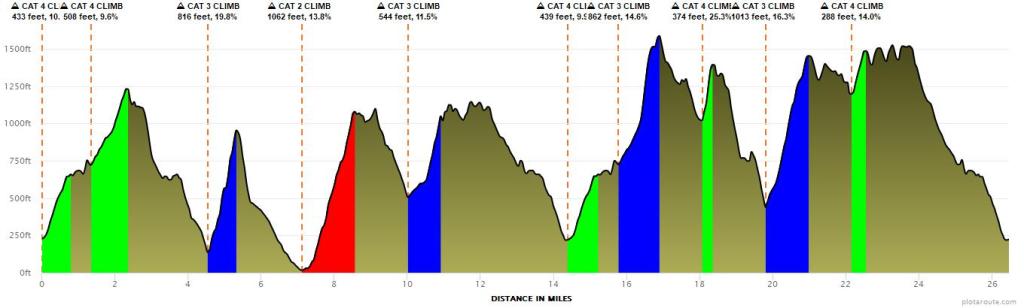
To my surprise, up until that 5th major climb – the ascent up Breakneck Ridge – the course was substantially more runnable than I had feared. This was great news for my initial confidence and my chronically injured ankle.
I was able to hike comfortably up hills, jog the flats, and let gravity take over on the descents for the first 10 miles or so. I was watching the clock because I felt some pressure from the cutoffs but I was staying on schedule.
The first cut off was a generous 3 hour soft cutoff at the 7.7 mile Cold Spring aid station. I was expecting to come in around 2:15 but cruised in around 2:05. Still a slower time than I would have liked or expected with better training but being even 10 minutes ahead of schedule was a big confidence boost. Unfortunately, the courses highest category climb immediately follows the aid station. I was happy to keep the pace under 30 minutes for this 1000ft climb that lasted just over a mile but it did take a lot out of me.
The forlorn bagpipe funeral march could be heard for the duration of the climb. Not until over a mile and near the top were the bagpipers visible making the trek rather surreal. It was a welcome if not melancholy serenade.
After a challenging descent, the cusp of the titular Breakneck Point ascent was like a smack in the face. It was without a doubt the coolest and most fun part of the course but it was a full stop once the scrambling started. Some of that was due to traffic, but a part of it was definitely due to difficulty and inexperience. I am able to get a little bit of scrambling practice in the Middlesex Fells near my home, and I have experienced some scrambling in the Catskills, so I’m not at all new to it but I definitely don’t have the confidence to scream up the rock slabs like some others.
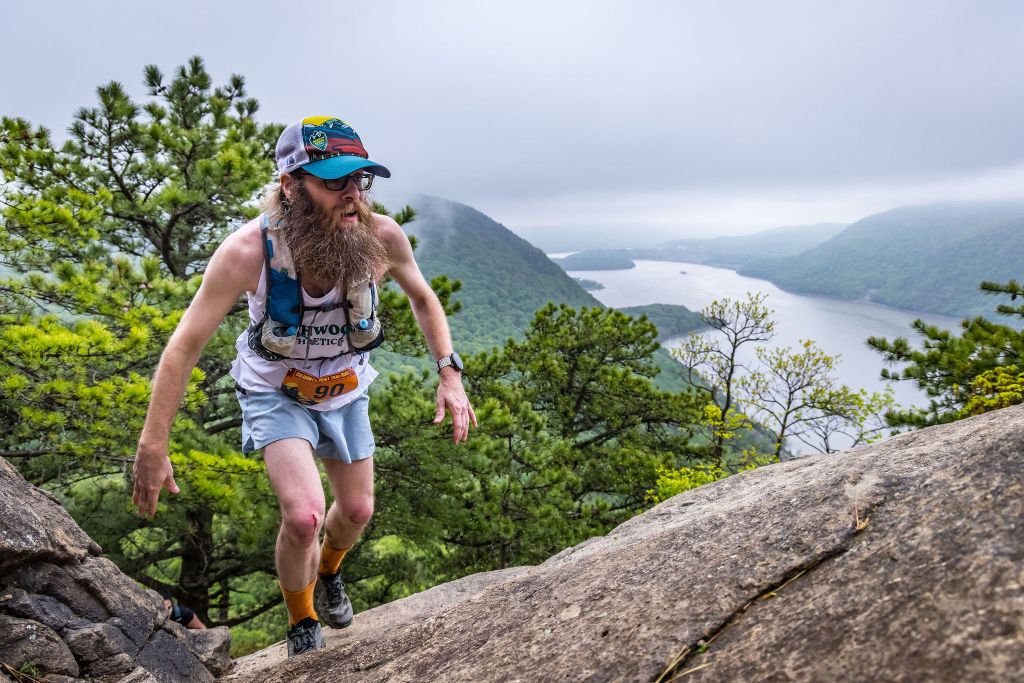
With how long it took to get up the ridge, and assessing how I was feeling, the first doubts crept into mind. The last cutoff along the course was a 5:15 hour cutoff at the midway point. I was doing the internal pacing calculations. I knew my time leaving the 1st aid station meant I had 3:10 to reach 15.3 miles which was still very much in reach. My principal concern as I reached the beginning of the long descent into the Settlement Camp was less about making the cutoff but how I was going to feel after spending 10-15 minutes with my drop bag, going to the bathroom, and pulling myself together for the next half.
The course really settles down as you approach the Settlement Camp which is really nice as is serves to settle your nerves a little. A respite from the challenging ups and downs gives you time to recoup any confidence lost by a less than desirable first half. The knee that I wanged wasn’t really hurting, I was jogging fairly well, but I was tired and definitely feeling stiff already.
I finished the first half in 4:49. Nearly a half hour before the cutoff meant I had more than enough time for the cutoff and I didn’t feel too terrible walking around camp, navigating my drop bag, and gathering myself together for the next half. The only remaining cutoff was the finishing cutoff of 11 hours. I would have 6 hours to run the next 12ish miles. However, I knew the climbs were going to be really tough from here on out and the descents were going to be frustratingly slower. Most importantly, I was currently uninjured and have had a bad start to the year because I’ve not been uninjured for much of it.
For what I think is the first time in my racing history, I decided to drop purely as a precaution. I could have kept going, I had time. I likely even would have finished. Even if the shorter second half of the course took an hour longer it still would have been within cutoff by a handful of minutes. But, I feared I wouldn’t enjoy it and similar fear of a setback with my ankle loomed large.
So I quit.
On my own terms.
I’ve been reflecting on this particular point all week. I’m still not sure how I feel about the decision.
On one hand, it feels like a “smart” decision. I avoided injury and would live to fight another day. The four days of painfully sore legs would seem to affirm my decision. Furthermore, I checked my CGM at each aid station and was hyperglycemic for the bulk of the 4:49 I was on course, despite very little caloric intake. Another justifiable reason to not continue.
However, on the other hand, it was just another half marathon to go. Well within my capability. Quitting sucks and feels bad, finishing is great and feels great. It feels cowardly and weak to quit because you think you could get hurt. Rationalizing or making excuses for a DNF shows a lack of self-awareness, while finishing when you think you can’t proves you’re stronger than you thought.
These two sides have been difficult to balance, the negative side often prevails. This is true and persistent between races, successful or not. Depression and anxiety can be harder things to overcome than the mountains and miles and that’s precisely why running shouldn’t and can’t replace therapy. It can serve a healthy function certainly but in my case particularly; depression, general anxiety, and other negative feelings that do happen to be directly related to poor performances are the greatest hinderances to a better training block moving forward. Simply put, it’s a catch-22. I want to run because I feel sad and I know running will provide a bit of relief, but I feel sad so I have no motivation to run, so I get sadder and run even less.
The next race on my calendar is the Sunapee Scramble on June 1st in Sunapee, NH. At less than half the distance and a third elevation it should make for a much more accommodating race than this and will hopefully help me reset my brain. I’ll be joined by friends from Northwoods Athletics and the competition will be elite and intense so it will just be great to be there. That said, I am hoping to run a faster pace than this and go sub-2 hours.
The Nitty Gritty
https://www.strava.com/activities/14376702014
https://www.rednewtracing.com/breakneck-point
15.3 miles with 4,150 ft of vertical gain in 4:48:54
Nutrition strategy:
- Breakfast was an oatmeal cup from Kodiak with 230 calories, 38g of carbohydrates (4g fiber and 12g of added sugar) 90 minutes before race start and a Kyoko shake 30 minutes before race start with 170 calories and 20g of carbohydrates (8g fiber, 4g sugar).
- Two 500ml water bottles with a heaping scope of Hammer’s Heed 2.0 drink mix. Heed 2.0 uses a cassava root for its starch and xylitol for its sweetener. I have found it to have generated smaller spikes in blood sugar than other liquid carbohydrate sources. I carried a backup baggie of the mix to replenish a water bottle if needed. I had intended to drink one full bottle before the first aid station and refilling it with plain water, consuming the other Heed bottle before the midway point. At which point I would fill both both bottles with Heed again.
- I carried four UCAN gels for an as needed boost during uphill hikes, however due to higher than anticipated glucose levels from the start of the race, I declined to consume anymore carbs. It’s tough to know what the right call is here, to be perfectly frank. I do not know if more carbs would cause my BG to continue to climb or just how much of an impedance that would even create. Tying performance to BG has thus far eluded me.
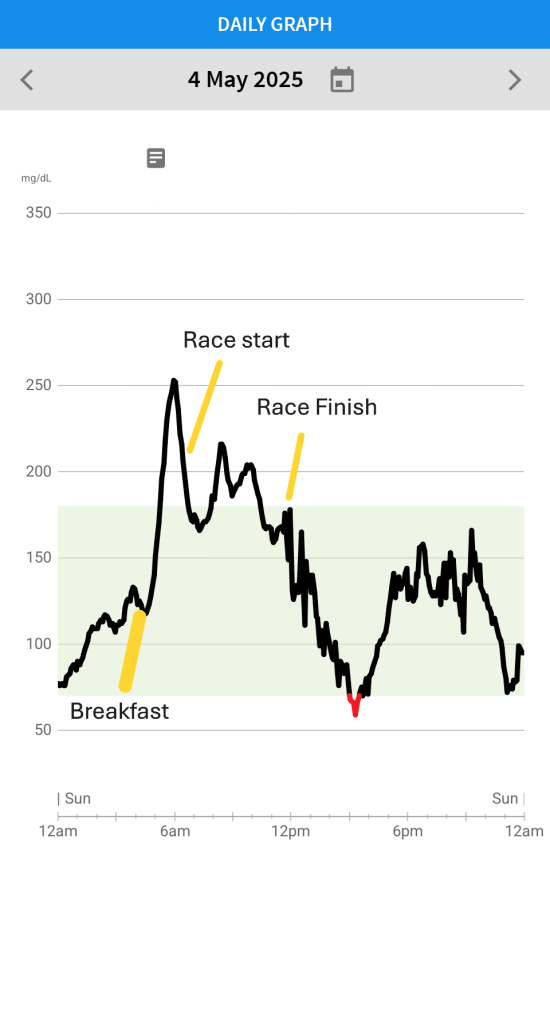
I overdid it for breakfast and my blood sugar spiked to over 250 mg/dL. It began to drop prior to the race start but as demonstrated even with minimal and gradual carbohydrate intake glucose levels remained above range for almost the entirety of the race. I likely could have skipped the shake, and probably should’ve tried to eat breakfast earlier but with a 6:30am race start, planning an earlier breakfast is tough to manage.
This chart also demonstrates the wild ride that takes place after strenuous activity is completed. BG levels remain in volatile downward trend for hours after the activity despite snacking and meals before returning to a somewhat more typical ebb and flow in the evening.
The bottom of the green In-Range is what is sometimes referred to as “relative hypoglycemia”. For me that can occur below 100 mg/dL, where I begin to feel the symptoms of low blood sugar before it is normally understood these symptoms would occur. That’s the In-Range green bar: 70 mg/dL to 180 mg/dL. Because for so many years my nominal has been much higher than a healthy person’s or even mildly diabetic or prediabetic person’s the symptoms of hypoglycemia like tremors in the hands and legs or visual impairment occur at BG levels still considered healthy and in range.
The red dip is actually a false reading, I confirmed with a reference blood glucose meter that I never actually dipped below 70 mg/dL despite my CGM reading in the 50s. You can read some of thoughts and experiences with CGM inaccuracy here and here.
The last thing I’ll say about the Breakneck Point 42k is that I’m probably going back next year. It’s technically a travel race which I don’t tend to repeat right away because of the time required and/or expense but this race is definitely worth going back to for revenge. Hopefully, I’ll see you there! Just remember the bug spray!
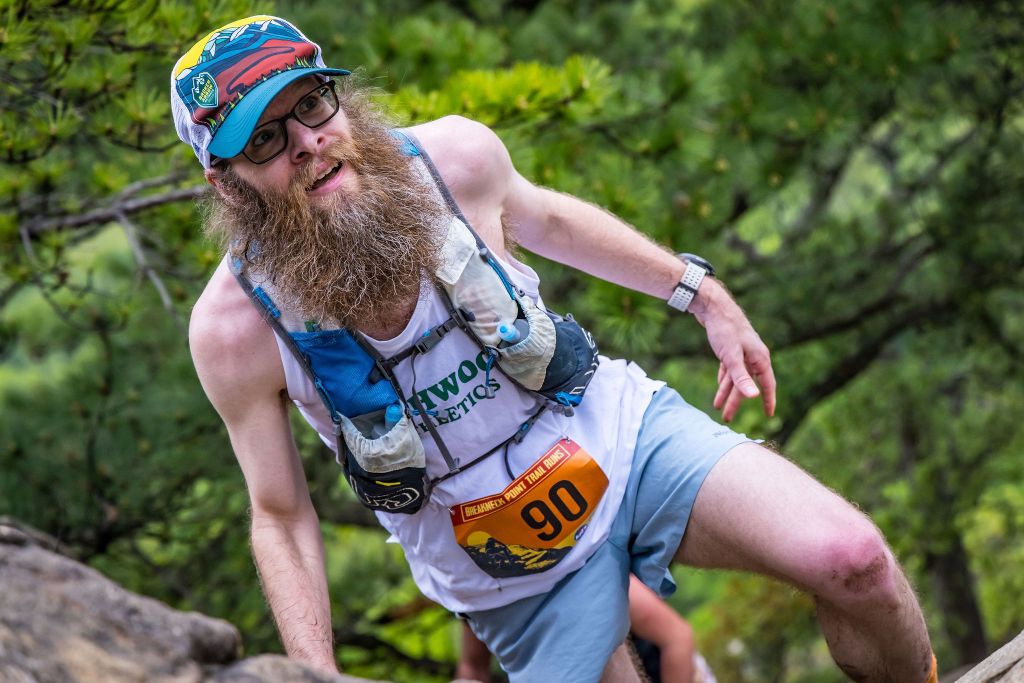




 Type 4 Fun!
Leave a reply to Kevin Hatton Cancel reply